Shoegaze and Grunge: The Other Side of Loud
How shoegaze and grunge grew up loud at the same time, why their walls of guitar diverged, and where the two scenes quietly overlapped in the early '90s.
In 1991, two scenes on opposite sides of the Atlantic both decided that the most important thing in the world was a wall of guitar. One looked at its shoes; the other looked at its boots. Shoegaze and grunge are rarely filed in the same crate, but they share a parent — distortion as architecture, not decoration — and understanding shoegaze tells you something real about why grunge sounded the way it did. This is the other side of loud.
What shoegaze actually is
Shoegaze is a British guitar style that crested between roughly 1988 and 1993, named for the way its players stared down at their effects pedals instead of working the crowd. The sound is built from layered, heavily processed guitars — chorus, reverb, delay, and pitch-shifting smeared into a dense, melodic haze. Vocals sit low in the mix, treated as another texture rather than the main event.
The genre’s foundational records are My Bloody Valentine’s Loveless (1991), Slowdive’s Souvlaki (1993), and Ride’s Nowhere (1990). Critics at the time used “shoegazing” as a mild insult, much the way “grunge” started as a sneer. As AllMusic and the British weeklies tell it, the press coined both terms to put bands in their place, and both stuck anyway.
The scene had its own geography too. Where grunge clustered around Seattle, shoegaze grew out of the Thames Valley towns west of London and a tight circle of bands on the Creation Records roster. The label’s willingness to bankroll My Bloody Valentine’s famously expensive, obsessive studio sessions is half the reason Loveless exists at all. Both scenes, in other words, depended on a sympathetic independent label that the mainstream wasn’t paying attention to yet.
Same decade, same volume, different goal
Grunge and shoegaze were near-simultaneous, and that’s the part people miss. Loveless and Nevermind came out within weeks of each other in the fall of 1991. Both leaned on overdriven guitars cranked past the point of clean tone. Both rejected the spandex showmanship of ’80s arena rock. Both treated loudness as the default rather than a climax.
Where they split is intent. Grunge used distortion to hit harder — the riff is a weapon, the dynamic shift from quiet verse to detonating chorus is the payoff. Shoegaze used distortion to dissolve, blurring individual notes into an immersive wash. One sound wants to punch you; the other wants to drown you. If you want the full mechanics of the heavy side, our piece on what defines the grunge sound breaks down the riffs, tunings, and dynamics that grunge built its identity on.
The vocal approach is just as telling. Grunge singers like Kurt Cobain or Layne Staley sat their voices right on top of the mix, raw and exposed, because the lyrics and the emotion were the point. Shoegaze vocalists did the opposite, mixing their voices down until the words became another smear of texture. Even the rhythm sections diverged: grunge drumming hits hard and tracks the dynamics, while shoegaze rhythm tends to lock into a steady pulse that lets the guitar haze float on top. Same raw materials, opposite priorities.
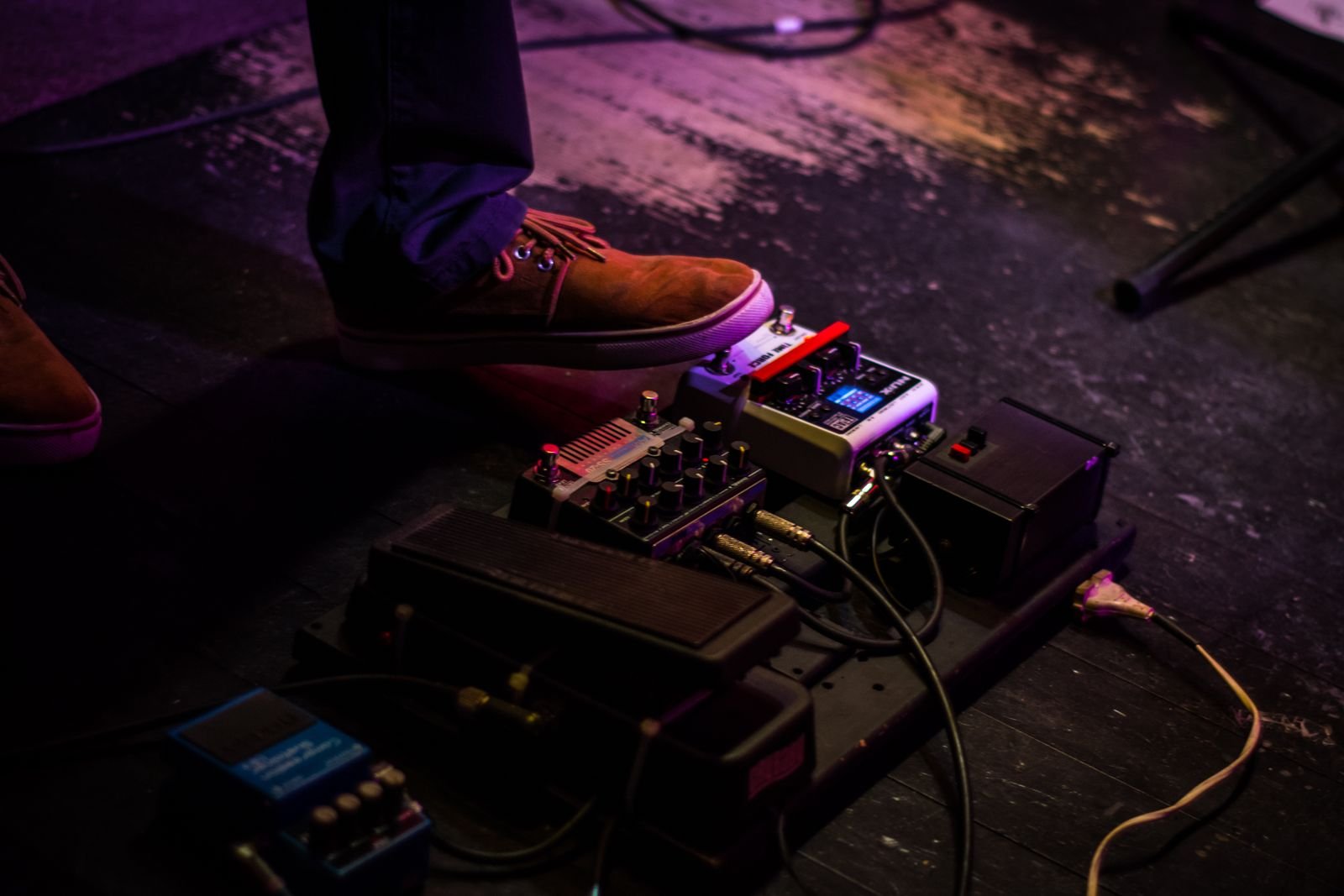
The pedalboard tells the story
You can hear the philosophical split in the gear. A grunge rig is usually short and brutal: a fuzz or distortion box slammed into a loud amp, with little between the guitar and the speaker. A shoegaze rig is a long signal chain where the effects are the instrument.
- Grunge essentials: fuzz (the Big Muff above all), a tube amp pushed into breakup, and not much else.
- Shoegaze essentials: modulation (chorus, flanger), pitch-shifting like the DigiTech Whammy, cavernous reverb, and stacked delays.
- The overlap: both worships at the altar of a loud, distorted guitar that fills every available frequency.
For a hands-on look at how grunge players assembled their tone, see our guide to the essential pedals for grunge tone, which covers the fuzz-forward end of this same family tree.

Where the two scenes actually touched
The crossover wasn’t only theoretical. Smashing Pumpkins are the clearest bridge: Billy Corgan stacked dozens of guitar tracks on Siamese Dream (1993) in a way that owed as much to My Bloody Valentine as to Black Sabbath, and the band toured the alt-rock circuit alongside grunge acts. Dinosaur Jr., whose ear-splitting volume and melodic squall predated both movements, is a shared ancestor that American grunge and British shoegaze both quietly claimed.
There’s also the festival reality. By 1992 and 1993, alternative bills routinely put a band chasing catharsis next to a band chasing atmosphere, and audiences didn’t see a contradiction. The same record-buyers who flipped Dirt to side two would happily put on Souvlaki afterward.
The traffic ran in both directions across the Atlantic, too. American underground noise — Dinosaur Jr., Sonic Youth, the early Sub Pop singles — was eagerly absorbed by British bands looking for new ways to make a guitar sound huge. Meanwhile, the dreamier, more textural instincts of shoegaze fed into the American alternative scene that grew up alongside grunge. By the time both labels were mythologized in retrospectives, the shared vocabulary was obvious: layered guitars, buried melody, and a refusal to treat distortion as a special effect.
A quick comparison
| Grunge | Shoegaze | |
|---|---|---|
| Peak years | 1989–1994 | 1988–1993 |
| Home base | Pacific Northwest, USA | England |
| Distortion’s job | Impact and aggression | Texture and immersion |
| Vocals | Raw, front and center | Buried, instrument-like |
| Dynamics | Quiet-loud whiplash | Sustained wash |
| Key record | Nevermind (1991) | Loveless (1991) |
The table flattens a lot of nuance, but it captures the core trade. Both genres asked the same question — what happens if the guitar gets enormous? — and answered it in opposite emotional registers. Outlets like Pitchfork and Rolling Stone have spent years tracing how these answers cross-pollinated into the broader alternative boom.
The shared legacy
Both scenes burned bright and short, and both got rediscovered. Shoegaze fed directly into the “nu-gaze” revival of the 2000s and into dream pop, while grunge’s DNA ran through post-grunge radio rock and beyond. When a modern band drowns a hook in fuzz and reverb at once, it’s drinking from both wells. The walls of guitar that grunge and shoegaze built in 1991 never really came down — they just got reassigned.
The revivals tell you which lesson each scene left behind. Shoegaze’s comeback was about texture: a new generation of bands chasing that bottomless, blissed-out guitar haze, often with bedroom recording gear that My Bloody Valentine could only have dreamed of in 1991. Grunge’s afterlife was about feeling: the raw vocal, the quiet-loud detonation, the sense that the song means it. Streaming-era playlists routinely shelve the two side by side under “alternative,” and younger listeners discovering either one tend to find their way to the other before long. The kinship that the press missed in the early ’90s is now plain to anyone scrolling a recommendations queue.
What ties it all together is a single conviction both scenes shared: that a loud guitar is not a problem to be cleaned up but a canvas. Grunge painted with hard edges and shoegaze painted with smeared ones, and the fact that the same brush produced such different pictures is exactly what makes the comparison worth making.
The bottom line
Shoegaze is grunge’s quieter, dreamier cousin: same love of overwhelming volume, opposite idea of what to do with it. Putting the two side by side sharpens what makes grunge grunge — the punch, the dynamics, the rawness that distortion serves rather than dissolves. If you want to keep pulling on that thread, start with what defines the grunge sound and the gear that built it in our essential pedals for grunge tone guide.